
By ESA Administrator
28th January 2026
The website Hector’s Rare Recordings has posted a very lovely set of recordings of the Suzuki Quartet, including the “Minuet” by Mozart included in the Suzuki Violin School Volume 7
https://www.youtube.com/watch?v=zWSd2Z59q8w
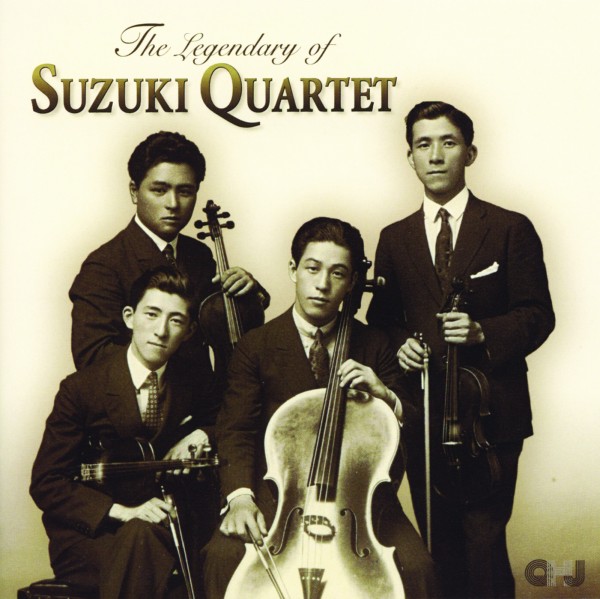
The recordings are from a CD titled "The Legacy of Suzuki Quartet" (QHJ-1003), released in 2008 by a Japanese label called Regulus Classics. Interestingly, the label's website notes that this CD was "Released only in Japan", which is likely why it hasn't been widely known internationally until now. It is still commercially available on the website here:
http://www.regulus-classics.com/labels/01.html#suzuki_quartet
The following is a translation of the album description provided by Ryugo Hayano, Professor of Physics at the University of Tokyo, and President of the Talent Education Research Institute. He was one of the first ten children to tour the US with Suzuki in 1964.
The Suzuki Quartet
Shin’ichi Suzuki (1898-1998) was born the second son of Masakichi Suzuki (1859-1944), Japan's first violin maker. Raised in a rich musical environment—surrounded by figures such as Nobu Koda (the first to perform string quartets in Japan) and her sister Ko Ando—Shin'ichi later moved to Berlin to study. There, he studied from 1921 to 1928 with Karl Klingler (1879–1971), who is best remembered for his string quartet, which, in different formations performed from 1905 until 1936, and famously made the world's first recording of Beethoven's string quartets.
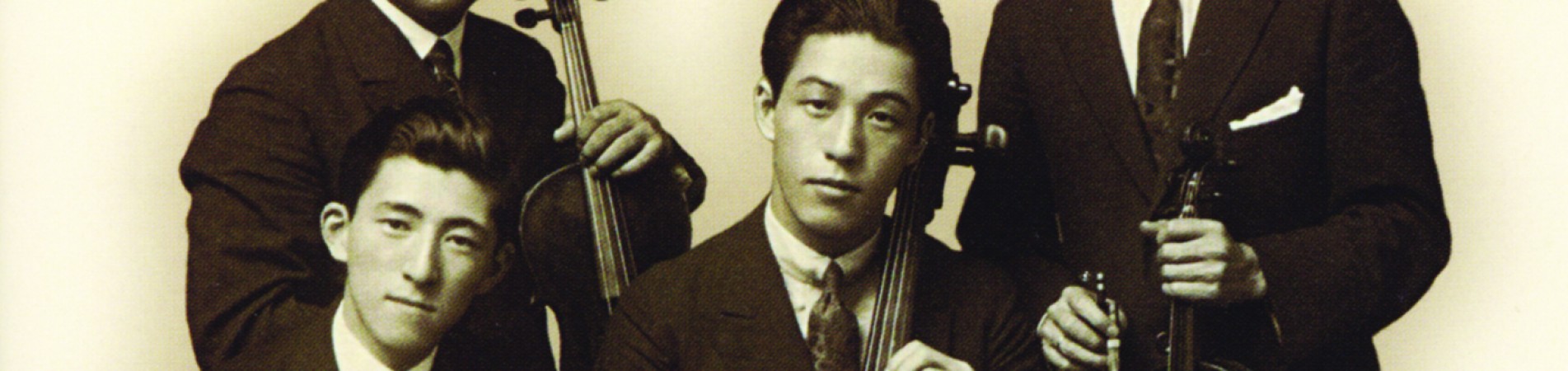
Soon after Shin’ichi’s return from Berlin in 1928, he formed the Suzuki String Quartet, together with the four brothers: Kikuo (1904–77) Akira (1899–1961) and Fumio (1900–45). Shin’ichi’s father Masakichi’s violinmaking
business boomed during the First World War, but by the late 1920s it was faltering. While Shin’ichi’s father and elder brothers Umeo (1889-1981) and Rokusaburô (1895-1945?) worked to shore up the violinmaking business, the younger brothers had to earn a living independently. Kikuo, who played second violin, had studied economics at Keiô University, where he had been a member of the University’s music society. Akira, who played the viola, had trained in his father’s business before studying violin with Andô Kô (née Kôda;1878-1963), one of the first violinists in Japan who for many years taught at the Tokyo Academy of Music. In the war years
Akira performed in Manchuria, for Mukden Radio broadcasts. Fumio studied cello with Heinrich Werkmeister in Tokyo, and with Julius Klengel (1859–1933) in Leipzig. Besides playing in the quartet and teaching, he
also played at the lead desk in the Tokyo Symphony Orchestra and composed.
While many of their recordings were originally released by Nippon Columbia, this CD marks the first time that the entire collection has been mastered from tapes created directly from the original metal master discs.
This commemorative album was released just before the 10th anniversary of the passing of Shin’ichi Suzuki, the founder of Talent Education.
The track "Genji Monogatari" (The Tale of Genji), composed by Fumio Suzuki, is a unique work for string quartet, recitation, soprano, and tenor, featuring a historical recitation by the famous poet Akiko Yosano.
Album Title: The Legacy of Suzuki Quartet
Tracks: Haydn, Schubert & Drigo: Serenade / Mozart: Minuet / Tchaikovsky:
Andante Cantabile / Ryoshu (Dreaming of Home and Mother) / Kokyo no Haika (The Old Folks at Home) / Old Black Joe / Deep River / Yoimachigusa / Ayageba Totoshi / Fumio Suzuki: Suite "Genji Monogatari"
Performers: Suzuki Quartet, Tamotsu Kinoshita (Tenor), Yoshiko Beltramelli (Soprano), Akiko Yosano (Recitation)
Product No: QHJ-1003 (Released Dec 5, 2008)
Recording: 1935–1938 (Columbia Recordings, restored from original metal
masters)
Status: Released only in Japan